
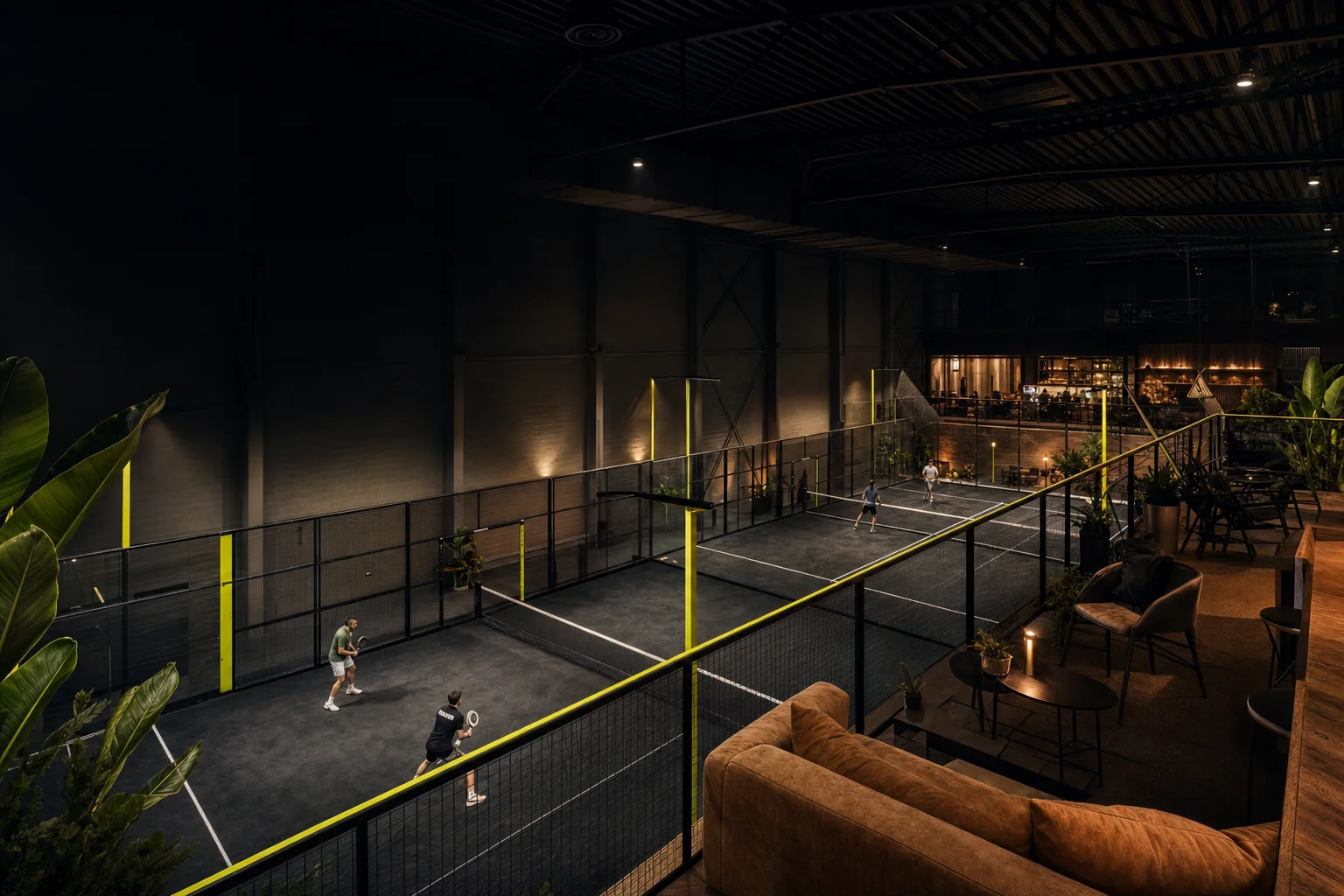
An indoor padel club can achieve an attractive operating margin because a small number of courts sell many recurring, digitally bookable hours. The model is also fixed-cost intensive: rent, staff and operations continue when court hours remain empty. Profitability therefore depends primarily on usable, sellable hours, not simply square metres.
The short answer: profitable, yes; automatic, no.
The Neuötting model ranges from 25% to 45% utilisation. Modelled annual revenue ranges from €352,200 to €624,360. The EBITDA spread is wider still: €131,853 in the downside, €262,966 in the base case and €394,079 in the upside. This demonstrates both the operating leverage and the risk of an overly optimistic demand assumption.
Each additional court hour meets a largely fixed cost base after variable costs.
Revenue starts with the court-hour engine.
The basic multiplication is simple: courts × opening hours × operating days × utilisation × price. The Neuötting model uses five courts, 18 opening hours per day, 30 days per month and €42 per hour. Capacity only becomes revenue when demand is activated in the right time windows. A full prime time cannot entirely offset weak mornings.
- 01Court booking
Dynamic peak/off-peak pricing and recurring plans.
- 02Coaching
Beginner courses, academy and individual training.
- 03Events & leagues
Recurring formats increase frequency and retention.
- 04Hospitality
Drinks, retail and dwell time increase average spend.
The cost structure determines how much revenue remains.
Court procurement and fit-out determine initial capital need. Thereafter, rent, staff, energy, cleaning, software, insurance, maintenance and marketing dominate. Neuötting models €429,302 of capital, five courts, 1,390 m², monthly rent of €3,475 and fixed monthly operating costs of €17,291. These project values are not universal industry benchmarks.
A cheap hall is only cheap if geometry, height, fire safety, parking and conversion costs work. Low rent can quickly be neutralised by expensive adaptation or an inefficient court layout.
Three scenarios show the range.
What ‘payback in under two years’ actually means.
In the upside scenario, modelled cumulative capital payback is reached in month 21. This is the ambitious upper end of the model, not a promise. The same point is month 29 in the base case and month 52 in the downside. A single payback figure without its utilisation assumption therefore says very little.
This does not automatically create an equivalent investor distribution. MorePadel plans quarterly distributions only where distributable profit exists and the company can distribute after taxes, costs, liquidity needs and necessary reserves. The final contractual documents are authoritative.
Model the cash flow yourself
The returns calculator shows the Neuötting upside scenario for amounts from €10,000, transparently as a model rather than a forecast.
Utilisation is the central sensitivity.
A 2026 master’s thesis on new indoor courts in Hamburg models about 5.4 occupied hours per court per day as the threshold needed to cover operating expenses in its realistic scenario. This is not a universal German break-even, but it confirms the direction: small changes in achievable, time-specific utilisation can materially shift the result.
Professional operations therefore begin before opening: validate catchment demand, test prime-time pricing, systematically activate beginners, schedule leagues and events early, and build off-peak user groups.
A number is only as good as its assumptions.
Build cost, opening timing, demand, price, staffing, energy, repairs and competition can differ from the model. Company participations are illiquid and can result in total loss. Historic or modelled figures are not a reliable indicator of future results.
The economically useful question is therefore not ‘What is the ROI of a padel club?’ It is: ‘What utilisation must this specific club achieve, at what prices, to generate distributable profit after all costs and reserves?’