
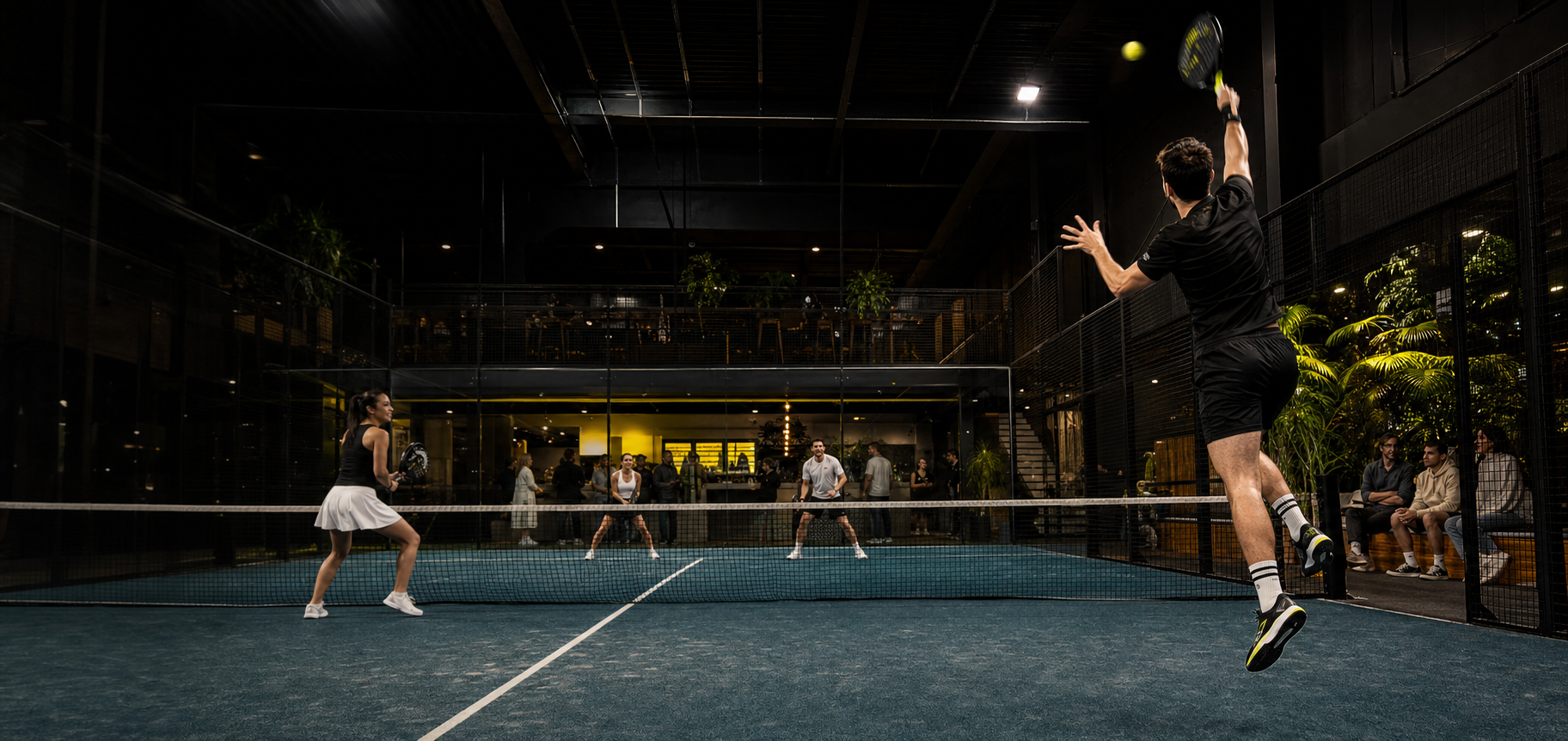
The 2026 Global Padel Report by Playtomic and Strategy& positions Germany among Europe’s most compelling build-out markets. The central investor insight is simple: the boom alone does not make a club profitable. Attractive club economics emerge when demand, indoor availability, pricing and ancillary offers are combined in a professional operating system.
The short answer: Germany has strong revenue levers, but no profit autopilot.
Three signals stand out: Germany is described as a hotspot with strong willingness to pay and play, monthly GMV per court rose to €6,400 in 2025, and 60% of commercial courts are indoors. Together, these improve the conditions for predictable, year-round revenue.
The objective is not simply more courts, but more economically attractive court hours, complemented by coaching, events, hospitality and membership models.
Germany is a hotspot, not yet a mature market.
Playtomic classifies Germany alongside the UK and Ireland as a hotspot: the ecosystem is still developing, while willingness to pay and play accelerates demand uptake. For Germany, the report specifically highlights ecosystem and infrastructure build-out.
That is economically interesting because professionally designed clubs do more than serve existing demand. Community, beginner formats and digital matchmaking can activate additional playing frequency. Yet the local catchment remains decisive: a global trend cannot compensate for a weak site.
Indoor makes demand more predictable and supports pricing.
Indoor coverage reduces weather exposure and seasonality. In Germany, this can support more bookable days, more stable peak and off-peak management, and reliable training, league and corporate formats. The report shows a 2025 median ticket of €42 per indoor reservation, with typical reservations lasting 60–90 minutes.
The advantage is not free: rent, fit-out, energy and financing must be weighed against the additional utilisation. Strong indoor economics therefore come not from the roof alone, but from the quality of the site and its operations.
The court-hour engine shows where profitability begins.
The report frames club economics as a court-hour engine. On the supply side, operating hours, utilisation and price per hour matter. On the demand side, active players per court, playing frequency and average ticket matter. Their interaction creates a resilient revenue base.
- 01More active hours
Indoor operations, reliable hours and off-peak programming.
- 02Better utilisation
Open matches, leagues and data-led capacity management.
- 03Intelligent pricing
Peak/off-peak rates, bundles and segment-specific offers.
- 04Higher frequency
Community and matchmaking reduce friction for the next game.
Germany’s next lever: turn a booking into a club visit.
In 2025, 84% of German Playtomic GMV comes from court bookings. Open matches account for 9%, academies for 4%, and leagues and tournaments for 3%. That indicates a solid core business and room for additional products.
Nine in ten top clubs surveyed in the report offer a holistic experience beyond the court. For Germany, facilities are described as a core business driver, with sauna access a defining feature of the club proposition. This can extend visits, differentiate the product and create additional revenue points from F&B to wellness.
Top clubs do not win with one metric, but with a system.
In Playtomic’s global benchmark, top performers combine scale, demand activation, pricing and digitalisation. The figures are not Germany-specific, but they show the direction of professional club management.
What the report does not prove.
The report does not publish Germany-specific EBITDA, return or payback figures. GMV is booking value processed, not company revenue or profit. Whether a specific club is profitable depends on rent, investment cost, staffing, energy, financing, local demand, utilisation and operating execution, among other factors.
That is why MorePadel evaluates projects through site data, investment budgets, ramp-up scenarios and operating KPIs rather than a generic industry multiple. The report supports the market thesis; each project must still prove its own economics.
Conclusion: the market provides tailwinds; the operator turns them into results.
Germany offers an attractive combination of growing demand, indoor relevance and underdeveloped ancillary offers. The winners will be clubs that actively manage every court hour and connect sport, community and hospitality into a repeatable experience.
See how MorePadel translates this market thesis into specific club concepts.
Non-binding enquiry · response usually within 2–3 business days